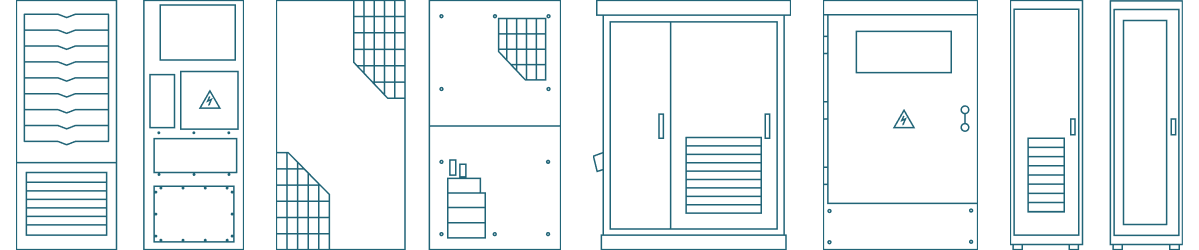
Server rack
Glossary defaultDefinition
A server rack is a standardized framework used to mount, organize, and support servers and other IT equipment. Server racks typically use the 19-inch rack format and organize equipment vertically using rack units (U).
In addition to servers, a rack can accommodate network switches, patch panels, power distribution equipment, storage systems, and other rack-mounted hardware.
Server racks are widely used in data centers, edge data centers, micro data centers, telecom infrastructure, and other environments where IT equipment needs to be installed efficiently within a defined physical footprint.
Context
Modern IT infrastructure often combines large amounts of computing, networking, storage, and power equipment within limited space.
Server racks provide a standardized structure for organizing this equipment while maintaining access for installation, cabling, cooling, and maintenance.
Rack design becomes particularly important as equipment density increases. High-density servers and networking equipment generate significant thermal loads, and the physical arrangement of equipment can directly influence airflow and cooling performance.
In distributed environments such as edge data centers and micro data centers, racks may also form part of a larger integrated system that combines computing equipment with cooling, power distribution, monitoring, and physical protection.
Technical insight
Server racks use standardized dimensions that allow compatible equipment from different manufacturers to be installed within the same mounting structure.
Important server rack characteristics include:
- Rack height
- Rack width
- Rack depth
- Load capacity
- Mounting rail configuration
- Equipment clearance
- Cable routing
- Airflow
- Power distribution
- Physical access
Selecting the appropriate rack requires consideration of both current equipment requirements and potential future expansion.
Rack units and equipment capacity
The vertical capacity of a server rack is measured in rack units, commonly abbreviated as U.
One rack unit corresponds to 1.75 inches (44.45 mm) of vertical mounting space. A 42U rack, for example, provides 42 standardized units for installing compatible equipment.
The number of available rack units does not necessarily represent the usable equipment capacity. Space may also be required for power distribution, cable management, airflow, and maintenance access.
Mounting rails
Rack-mounted equipment is attached to vertical rack rails inside the server rack.
The position and configuration of these rails must match the dimensions and mounting requirements of the installed equipment. Adjustable rails provide flexibility for servers and other hardware with different depths.
Correct rail positioning also helps ensure equipment loads are properly supported.
Airflow and cooling
Most rack-mounted servers use front-to-back airflow.
Cool air enters through the front of the server, passes across heat-generating components, and exits as warmer air through the rear.
Effective airflow management helps prevent heated exhaust air from recirculating toward equipment intakes. Poor equipment placement, obstructed airflow, or unmanaged cabling can contribute to hotspots and reduced cooling efficiency.
As rack power density increases, cooling requirements also increase. High-density deployments may require more advanced air cooling or liquid cooling strategies.
Cable management
Server racks can contain significant amounts of power and network cabling.
Structured cable management helps:
- Maintain equipment accessibility
- Simplify installation and maintenance
- Prevent cables from restricting airflow
- Reduce strain on connectors
- Improve organization
Vertical and horizontal cable management systems are commonly used depending on rack configuration and equipment density.
Power distribution
Servers and network equipment require reliable power distribution within the rack.
Rack-mounted or vertically installed power distribution equipment can distribute electrical power to individual devices while supporting organized cabling and equipment maintenance.
For critical applications, redundant power supplies and backup power systems may be used to improve availability during power interruptions or equipment failures.
Server rack vs server cabinet
A server rack generally refers to the open mounting framework used to install IT equipment.
A server cabinet incorporates a rack structure within an enclosed housing that may include doors, side panels, locks, cable entry, and additional physical protection.
Server cabinets are often selected when equipment requires greater security, environmental separation, or controlled access.
Key advantages
- Standardizes IT equipment mounting
- Organizes servers and networking equipment
- Supports efficient use of vertical space
- Simplifies equipment installation and maintenance
- Supports structured airflow and cable management
- Enables scalable IT infrastructure
Applications
Data center and IT infrastructure
Modern data center and IT infrastructure uses server racks to organize computing, networking, storage, and power equipment within standardized equipment layouts.
Edge data centers
Distributed edge data centers use server racks to integrate computing and networking capacity close to users, devices, and data sources.
Micro data centers
A micro data center may integrate one or more server racks with cooling, power distribution, monitoring, and physical protection within a compact deployment.
Telecom and connectivity
Telecom and connectivity infrastructure uses server racks for network equipment, routing hardware, fiber systems, computing equipment, and supporting power infrastructure.
Industrial automation
Modern industrial automation increasingly uses rack-mounted computing and networking equipment to support control systems, data processing, machine vision, and industrial edge computing.
Defense and security
Defense and security applications can use server racks to organize computing, communications, networking, surveillance, and other mission-critical electronic equipment.
FAQ
A server rack is a standardized structure designed to mount and organize servers, networking equipment, storage systems, and other IT hardware.
U stands for rack unit and represents the standardized vertical measurement used for rack-mounted equipment. One rack unit equals 1.75 inches (44.45 mm).
A server rack is the mounting framework used to support IT equipment. A server cabinet incorporates the rack within an enclosed housing that provides additional physical protection, security, and equipment access control.
Infrastructure solutions