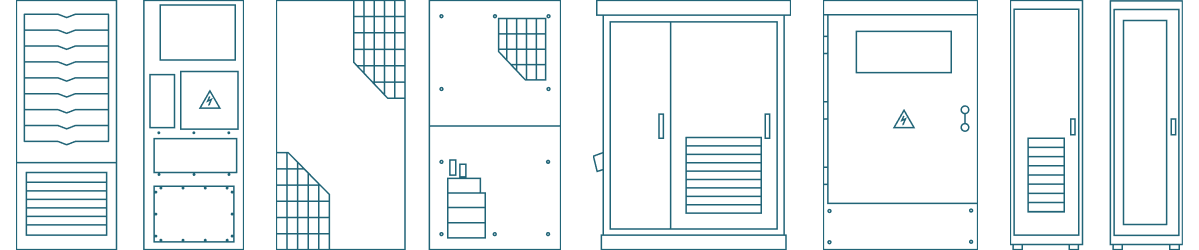
Power distribution board
Glossary poweringDefinition
A power distribution board is an electrical system that receives power from a primary source and distributes it to multiple circuits within an outdoor enclosure, server cabinet, or infrastructure system.
Context
Power distribution boards are essential in telecom & connectivity, data center & IT infrastructure, energy & grid infrastructure, and industrial automation. They ensure that power is safely and efficiently delivered to all connected equipment.
In enclosure-based systems, distribution boards manage DC power and AC power flows, supporting components such as battery modules, cooling systems, and network equipment. They are commonly integrated into outdoor enclosures and equipment racks, forming a central part of the electrical infrastructure.
Technical insight
Power distribution boards control, protect, and distribute electrical power within a system.
Key principles and components:
- Power input and distribution
It receives power from grid connections, solar hybrid power systems, and off-grid power systems, and distributes it to multiple output circuits. - Circuit protection
Includes protection devices such as breakers and fuses to prevent overload, short circuits, and system failure. - AC and DC distribution
Supports both AC and DC power systems, depending on application requirements. - Load management and balancing
Works with load management to ensure balanced power distribution and efficient system operation. - Integration with energy storage
Interfaces with battery modules and energy storage systems (ESS) (future) to manage stored energy. - System monitoring and control
May include monitoring systems to track power usage, faults, and system status. - Thermal considerations
Generates heat that must be managed through:- airflow management
- cooling capacity
- Integration with cabinet cooling systems
- Mechanical integration
Installed within:
Power distribution boards ensure safe, reliable, and efficient delivery of power across systems.
Key advantages
- Centralized power control and distribution
- Enhances system safety and protection
- Supports efficient load balancing
- Enables scalable system design
- Improves reliability and uptime
- Integrates with hybrid and off-grid systems
Applications
- Telecom infrastructure
- Data center and IT systems
- Industrial automation
- Energy and grid infrastructure
- Oil, gas, and mining
- Defense and security
FAQ
It is a system that distributes electrical power from a main source to multiple circuits.
It ensures safe, controlled, and reliable delivery of power to all connected equipment.
Yes, depending on design, they can support both AC and DC power systems.
powering solutions