Insights 4 min. read — Apr 20, 2026
How to choose the right outdoor enclosure
A practical guide to selecting the right outdoor enclosure based on environment, cooling needs, security, and system requirements.
Choosing the right outdoor enclosure is critical for protecting equipment and ensuring long-term system reliability in exposed environments. Whether deployed in telecom & connectivity, energy & grid infrastructure, or industrial automation, the enclosure directly impacts performance, maintenance, and lifespan.
Outdoor environments introduce challenges such as temperature fluctuations, moisture, dust, and physical threats. Selecting the wrong enclosure can lead to overheating, corrosion, or even system failure.
This guide outlines the key factors engineers and decision-makers should consider when selecting an outdoor enclosure for their application.
Understanding outdoor enclosure requirements
An outdoor enclosure is more than a protective box—it is an integrated system that must balance environmental protection, thermal performance, structural integrity, and security.
Key requirements include:
- Protection against dust and water (IP Rating, NEMA ratings)
- Resistance to environmental exposure and corrosion
- Adequate cooling capacity and airflow management
- Structural stability (including wind load rating and seismic rating)
- Security through vandal-resistant design and access control (physical)
Each of these factors must be evaluated in relation to the specific deployment environment.
Key factors to consider
1. Environmental conditions
The operating environment is the most important factor when selecting an enclosure.
Consider:
- Temperature extremes and solar exposure
- Humidity and condensation risks
- Dust, sand, or airborne contaminants
- Coastal or industrial environments causing corrosion
For harsh environments, enclosures may need to comply with standards such as Telcordia GR-487 and include enhanced sealing and material protection.
2. Thermal management requirements
Heat generated by equipment must be effectively managed to avoid overheating.
Key considerations:
- Total cooling capacity required
- Internal heat load from equipment
- Use of:
- Efficiency of airflow management
For high heat loads, larger systems such as walk-in enclosures may be required, while smaller systems may use compact cooling solutions.
3. Enclosure type and design
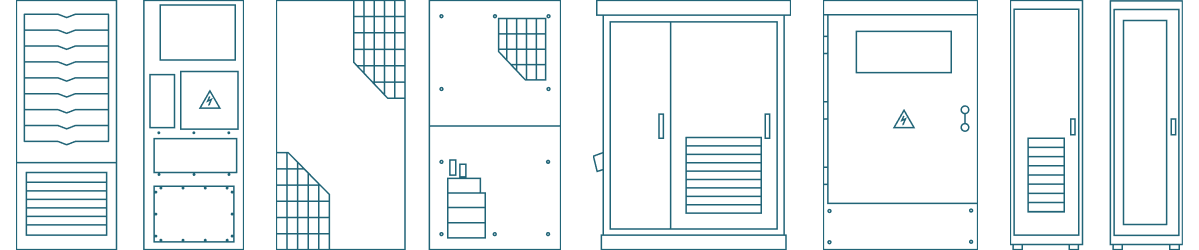
Different enclosure types offer varying levels of protection and performance:
- Single-walled enclosure → cost-effective, relies on active cooling
- Double-walled enclosure → improved thermal insulation and reduced heat gain
- Walk-in enclosure → supports large systems and internal access
The choice depends on system size, environmental conditions, and maintenance needs.
4. Equipment and space requirements
The size and complexity of installed equipment determine enclosure configuration.
Consider:
- Use of equipment racks and server cabinets
- Equipment height defined by rack unit (U)
- Required load capacity for heavy components
- Future expansion and scalability
Proper planning ensures efficient use of space and avoids costly redesigns.
5. Security and access control
Outdoor infrastructure is often exposed to unauthorized access and vandalism.
Key features include:
- Vandal-resistant construction
- Secure locking mechanisms
- Access control (physical) systems
- Intrusion protection for monitoring and alerts
Security should be integrated into the overall enclosure design rather than added as an afterthought.
6. Structural and compliance requirements
Enclosures must withstand environmental and mechanical stress.
Key considerations:
- Compliance with IP Rating, NEMA ratings, and Telcordia GR-487
- Resistance to wind load rating and seismic rating conditions
- Long-term durability in harsh environments
These factors ensure that the enclosure performs reliably over time.
Real-world implications
In real-world deployments, enclosure selection has direct consequences for system performance and operational efficiency.
Common mistakes include:
- Undersizing the enclosure
Leads to limited space, poor airflow management, and reduced scalability - Underestimating thermal requirements
Results in insufficient cooling capacity and overheating - Ignoring environmental exposure
Causes accelerated corrosion and system degradation - Overengineering the solution
Using overly complex enclosures where simpler solutions would suffice increases cost without added value
These issues are particularly critical in remote sites where maintenance is difficult and downtime is costly.
Engineering perspective
From an engineering standpoint, selecting the right enclosure is a system-level decision.
Key considerations:
- Thermal load calculation
Accurate estimation of heat load ensures proper cooling capacity - System integration
The enclosure must support:- DC power systems
- battery modules
- cooling infrastructure
- Airflow and cooling optimization
Effective airflow management is essential for maintaining stable operating conditions - Structural integrity
Proper load capacity, anchoring, and compliance with structural standards - Security integration
Combining vandal-resistant design with intrusion protection and access control
A well-designed enclosure integrates all these aspects into a single, reliable solution.
Practical decision guide
Choose a compact outdoor enclosure when:
- Equipment footprint is small
- Heat loads are moderate
- Space is limited
- Cost and deployment speed are priorities
Choose a double-walled or advanced enclosure when:
- Thermal insulation is required
- Solar exposure is high
- Environmental conditions are harsh
Choose a walk-in enclosure when:
- Multiple systems must be integrated
- Internal access is required
- Heat loads are high
- Long-term scalability is needed
Key takeaways
- Outdoor enclosures must balance protection, cooling, and structural integrity
- Environmental conditions are the primary selection factor
- Cooling capacity and airflow management are critical for performance
- Security features must be integrated from the start
- Structural and compliance requirements ensure long-term reliability
- The right choice depends on system size, environment, and scalability

Latest news & insights