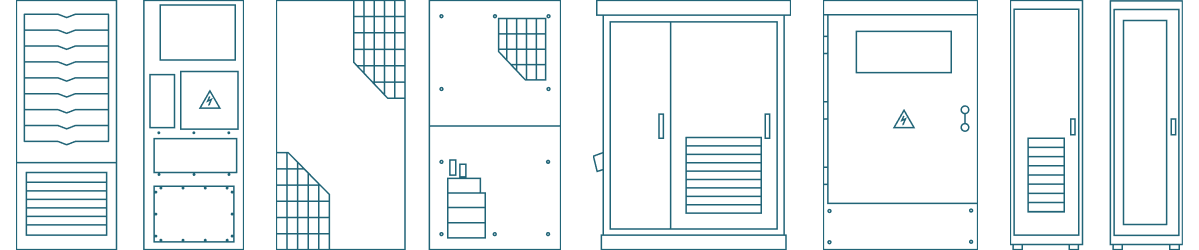
Micro data center cooling
Glossary defaultDefinition
Micro data center cooling refers to the systems and strategies used to remove heat from servers, networking equipment, power electronics, and other equipment installed within a micro data center.
Because micro data centers integrate significant computing capacity within a small physical footprint, cooling systems must manage concentrated thermal loads while using limited installation space.
Depending on equipment density, ambient conditions, enclosure design, and cooling requirements, micro data centers may use air conditioning, heat exchangers, free cooling, liquid cooling, or combinations of multiple cooling technologies.
Context
Micro data centers bring computing resources closer to users, connected devices, and data sources without requiring a conventional data center facility.
This distributed architecture creates different cooling challenges from those found in large centralized data centers. A micro data center may contain servers, networking equipment, power distribution, backup power, and other supporting infrastructure within a single cabinet, enclosure, or shelter.
The concentration of equipment creates significant thermal loads within a limited volume. At the same time, many edge deployments operate in telecom, industrial, outdoor, or remote environments where ambient temperatures and environmental conditions cannot be tightly controlled.
Effective cooling must therefore balance thermal performance, available space, environmental protection, energy efficiency, and reliability.
Technical insight
Cooling a micro data center requires understanding both the amount of heat generated and how that heat moves through the compact installation.
Important design factors include:
- IT equipment power consumption
- Equipment density
- Thermal load
- Ambient temperature
- Available airflow
- Enclosure dimensions
- Environmental protection
- Cooling system capacity
- Redundancy requirements
- Energy efficiency
Because these factors interact, cooling should be considered as part of the overall micro data center design rather than as a separate system added after the equipment layout has been defined.
Thermal load and cooling capacity
Servers, switches, storage systems, and power electronics convert electrical energy into heat during operation.
The total thermal load determines the amount of heat that the cooling system must remove to maintain appropriate internal temperatures.
Cooling capacity should account for the expected IT load as well as additional heat sources and environmental conditions. Undersized cooling can result in excessive temperatures, while unnecessary oversizing can increase energy consumption and operating costs.
Accurate cooling calculations become increasingly important as more computing capacity is installed within the same physical footprint.
Airflow management
Air-cooled micro data centers depend on effective airflow through both the IT equipment and the surrounding enclosure.
Most servers move air from front to rear. The surrounding cooling architecture must therefore deliver sufficiently cool air to equipment intakes while preventing heated exhaust air from recirculating.
Poor airflow management can create hotspots even when the installed cooling system provides sufficient total cooling capacity.
Equipment placement, cable routing, rack configuration, and the position of cooling equipment should therefore be considered together.
Air conditioning
Active air conditioning provides controlled cooling regardless of whether outside temperatures are suitable for passive heat rejection.
This makes it particularly useful for outdoor and remote micro data centers operating across wide ambient temperature ranges.
Air conditioners can also maintain a closed internal environment, allowing the enclosure to retain environmental protection while heat is transferred to the outside.
Heat exchangers and free cooling
Where ambient conditions allow, heat exchangers or free cooling can reduce the amount of mechanical cooling required.
An air-to-air heat exchanger transfers heat between separated internal and external air circuits without directly introducing outside air into the protected equipment environment.
Free cooling can use favorable outside temperatures to reduce compressor operation and improve overall cooling system efficiency.
Hybrid approaches can combine passive or economizer-based cooling with active air conditioning to adapt cooling operation as ambient conditions change.
Liquid cooling
As computing density increases, conventional air cooling may become less practical.
Liquid cooling transfers heat using a circulating coolant and can remove significant thermal loads without requiring equally large volumes of airflow.
Direct-to-chip cooling can bring the cooling medium close to high-power processors through cold plates, making liquid cooling particularly relevant for AI, high-performance computing, and other high-density edge workloads.
Liquid-to-air cooling can also be useful in micro data centers where facility water infrastructure is unavailable, allowing collected heat to ultimately be rejected to ambient air.
Environmental protection
Cooling design must account for the environment surrounding the micro data center.
Outdoor installations may be exposed to:
- Dust
- Rain and moisture
- High and low temperatures
- Solar radiation
- Corrosion
- Contaminants
An electrical enclosure or shelter can isolate sensitive IT equipment from these conditions, but increased environmental protection can also limit natural ventilation.
Cooling and enclosure design must therefore be coordinated to maintain both thermal performance and the required level of protection.
Reliability and redundancy
Micro data centers can support critical applications where equipment downtime has significant operational consequences.
Cooling system redundancy can reduce the risk that a single cooling failure causes equipment temperatures to exceed acceptable limits.
The appropriate redundancy strategy depends on thermal load, equipment criticality, environmental conditions, and the time required for maintenance personnel to reach the site.
Remote monitoring can further improve reliability by identifying temperature changes, cooling faults, or abnormal operating conditions before they result in service interruptions.
Key advantages
- Maintains stable temperatures in compact computing environments
- Supports higher equipment density
- Reduces the risk of localized hotspots
- Enables computing equipment to operate in distributed environments
- Supports indoor and outdoor micro data center deployments
- Can improve energy efficiency through adaptive cooling strategies
Applications
Micro data center cooling is used across several Vikinor industries.
Data center and IT infrastructure
Modern data center and IT infrastructure uses compact cooling solutions to support distributed computing installations where conventional data center cooling infrastructure is unavailable.
Telecom and connectivity
Modern telecom and connectivity infrastructure increasingly combines network equipment with local computing resources. Micro data center cooling supports these installations at telecom sites, fiber networks, and other distributed network locations.
Industrial automation
Edge computing within industrial automation places servers and networking equipment close to machines and production processes, creating a need for reliable cooling in industrial environments.
Energy and grid infrastructure
Distributed computing within energy and grid infrastructure supports monitoring, control, grid management, and energy storage applications where IT equipment may operate at remote or outdoor sites.
Defense and security
Distributed computing used in defense and security applications may require compact cooling systems capable of supporting IT and communications equipment in remote or environmentally demanding locations.
FAQ
Micro data centers concentrate servers, networking equipment, and supporting infrastructure within a small footprint. Dedicated cooling removes the resulting heat and maintains appropriate equipment temperatures.
Micro data centers can use air conditioning, heat exchangers, free cooling, liquid cooling, or hybrid cooling architectures. The appropriate technology depends on thermal load, equipment density, ambient conditions, and environmental requirements.
Micro data center cooling must provide the required thermal performance within a much smaller footprint and may need to operate in outdoor, industrial, telecom, or remote environments rather than a controlled data center facility.
Infrastructure solutions