Insights 6 min. read — Jun 3, 2026
Airflow design in electrical enclosures
Learn how effective airflow design improves cooling performance, prevents hotspots, and increases the reliability of electrical enclosures in demanding environments.
Effective airflow design is one of the most important yet often overlooked aspects of enclosure cooling. Whether an enclosure houses telecom equipment, power systems, industrial controls, or network infrastructure, the way air moves through the enclosure directly impacts temperature, reliability, and equipment lifespan.
Many cooling problems are not caused by insufficient cooling capacity but by poor airflow distribution. Even when a cooling system is properly sized, restricted airflow can create localized hotspots that reduce performance and accelerate component degradation.
This article explains how airflow works inside electrical enclosures, the factors that influence cooling performance, and the practical design principles that help maintain stable operating temperatures in both indoor and outdoor environments.
Understanding airflow in electrical enclosures
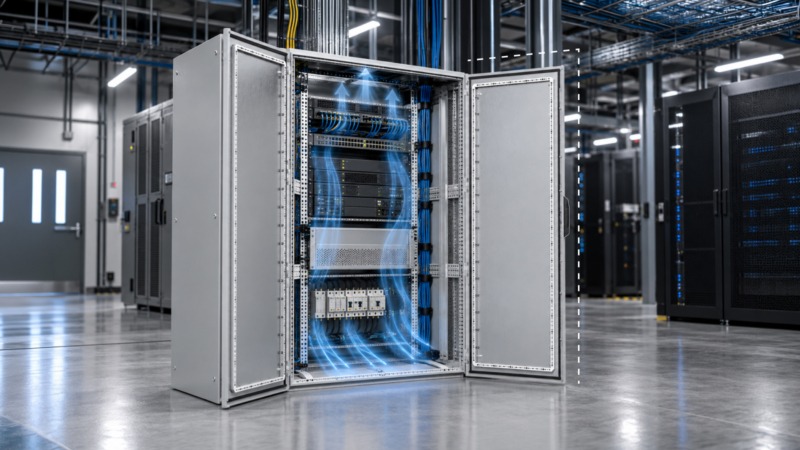
Airflow design is the process of controlling how air moves through an enclosure to remove heat from equipment and distribute cooling evenly.
As electrical equipment operates, it generates a thermal load that must be transferred away from components through effective heat transfer. Without adequate airflow, heat accumulates around equipment, creating temperature differences and reducing overall cooling performance.
The goal is not simply to move air, but to create predictable airflow paths that maximize cooling efficiency and minimize temperature variations throughout the enclosure.
Effective airflow design becomes increasingly important as equipment density increases and more components compete for limited cooling capacity.
Key factors that influence airflow performance
Several design factors determine how effectively air moves through an enclosure.
Equipment layout and placement
The arrangement of equipment has a major impact on airflow performance.
Consider:
- Component spacing
- Air intake and exhaust locations
- Obstructions within the enclosure
- Service access requirements
Poor placement can block airflow paths and create areas where heat becomes trapped.
Proper airflow management begins with thoughtful equipment positioning and sufficient clearance around heat-generating components.
Cable routing and internal obstructions
One of the most common airflow problems is excessive cabling.
Poor cable management can:
- Restrict airflow paths
- Create turbulence
- Block cooling air from reaching critical equipment
- Increase the risk of localized overheating
Organized cable routing improves both cooling performance and serviceability.
Heat sources and thermal distribution
Not all components generate heat equally.
High-power devices such as:
- Rectifiers
- Power supplies
- Battery chargers
- Network equipment
often become concentrated heat sources.
Understanding the enclosure’s overall thermal load helps identify where airflow should be prioritized.
Ventilation strategy
Effective enclosure ventilation depends on matching airflow design to the cooling method being used.
Ventilation approaches may include:
- Natural convection
- Forced-air circulation
- Heat exchanger systems
- Air conditioning systems
Each approach creates different airflow requirements and design constraints.
Environmental conditions
External conditions can significantly influence airflow effectiveness.
In harsh outdoor environments, factors such as:
- High ambient temperatures
- Solar heat gain
- Dust contamination
- Humidity
can reduce cooling performance and place additional demands on enclosure design.
These challenges are particularly important when designing an outdoor enclosure for critical infrastructure applications.
Organizations seeking to reduce operating costs often combine optimized airflow design with energy-efficient cooling for remote sites.
Real-world implications and common mistakes
Poor airflow design often causes problems that are difficult to identify during initial commissioning.
Hotspots and uneven cooling
A common misconception is that a lower average enclosure temperature guarantees effective cooling.
In reality, localized hotspots may still exist.
Poor airflow distribution can create significant temperature gradients between different areas of the enclosure, causing certain components to operate at much higher temperatures than others.
Restricted airflow paths
Equipment upgrades are often added without reviewing airflow impact.
Additional cables, devices, and accessories can gradually restrict airflow and reduce cooling effectiveness.
This is one reason why proper cable management should be considered part of the cooling strategy rather than simply an organizational task.
Ignoring airflow during cooling system selection
Cooling equipment is sometimes selected based solely on capacity calculations.
However, even properly sized systems may perform poorly if airflow distribution is inadequate.
When evaluating enclosure cooling, airflow design and thermal management should always be considered together.
For a broader discussion on capacity calculations, see our guide on how to size cooling for electrical enclosures.
Condensation and moisture issues
Airflow also influences moisture control.
Poor air circulation can create cold surfaces and localized moisture accumulation, increasing the risk of condensation.
This becomes especially important in sealed outdoor installations where environmental conditions fluctuate throughout the day.
For additional guidance, see preventing condensation in sealed enclosures.
Engineering perspective: Airflow and cooling system performance
From an engineering standpoint, airflow design must be integrated with the selected cooling technology.
Active cooling systems
In systems using active cooling, airflow must be directed toward critical heat sources while maintaining uniform temperature distribution throughout the enclosure.
Poor internal airflow can significantly reduce the effectiveness of even high-capacity cooling systems.
Air-to-air heat exchangers
An air-to-air heat exchanger removes heat without mixing internal and external air streams.
To operate efficiently, airflow paths must be carefully designed on both sides of the heat exchanger.
Free cooling and economizer systems
Systems using free cooling or economizer cooling rely heavily on airflow design to maximize energy efficiency.
Improper airflow distribution can reduce the effectiveness of these solutions and limit potential energy savings.
For a comparison of cooling strategies, see active vs passive cooling in telecom shelters.
Practical guidance: Improving airflow design
When designing or upgrading an enclosure, consider the following best practices:
1. Identify major heat sources
Map all significant heat-generating components and understand the enclosure’s overall thermal load.
2. Create clear airflow paths
Ensure cooling air can move freely between intake and exhaust locations.
Avoid unnecessary obstructions and apply proper airflow management principles throughout the enclosure.
3. Improve cable organization
Use structured cable management practices to reduce airflow restrictions and simplify maintenance.
4. Select the appropriate cooling method
Different applications require different cooling strategies.
Factors to consider include:
- Heat load
- Ambient temperature
- Environmental contamination
- Enclosure sealing requirements
For additional guidance, see how to choose the right cooling solution for outdoor enclosures.
5. Validate cooling performance
Where possible, verify airflow patterns and temperature distribution during testing.
This helps identify hotspots and confirms that cooling capacity is being utilized effectively.
6. Consider environmental conditions
Account for ambient temperature, dust, moisture, and condensation risks during the design phase.
These factors become increasingly important in outdoor applications and remote infrastructure deployments.
Key takeaways
- Effective airflow design is essential for reliable enclosure cooling.
- Poor airflow distribution can create hotspots even when cooling capacity is sufficient.
- Equipment placement and cable management significantly influence airflow performance.
- Environmental conditions affect airflow effectiveness and cooling requirements.
- Airflow design should be considered alongside cooling system selection.
- Proper airflow management improves reliability, efficiency, and equipment lifespan.

Latest news & insights