Insights 3 min. read — Mar 9, 2026
What IP ratings really mean for your equipment
IP ratings define how well an enclosure protects equipment from dust and water, but understanding what these ratings mean in real operating environments is essential for reliable infrastructure design.
When selecting equipment for outdoor or industrial environments, you will often see specifications such as IP55, IP65, or IP67 listed in product documentation. These numbers represent an Ingress Protection (IP) rating, an international standard that defines how effectively an enclosure protects internal components from dust and water.
While IP ratings are widely used, their meaning is often misunderstood. Choosing the wrong protection level can lead to equipment failure, condensation problems, or unnecessary costs.
Understanding what IP ratings actually represent—and how they apply to real installations—helps engineers design more reliable infrastructure systems.
Understanding the IP rating standard
IP ratings are defined by the IEC 60529 standard and consist of two digits:
IPXY
- X: Protection against solid objects and dust
- Y: Protection against water ingress
Higher numbers indicate stronger protection.
For example:
| Rating | Protection level |
|---|---|
| IP 54 | Limited dust protection and protection from water spray |
| IP 55 | Dust-protected and protected against water jets |
| IP 65 | Dust-tight and protected against water jets |
| IP 67 | Dust-tight and protected against temporary immersion |
These ratings are determined through controlled laboratory tests designed to simulate specific environmental conditions.
What IP ratings do (and don’t) guarantee
One of the most common misconceptions is that higher IP ratings always mean better equipment protection. While higher ratings provide stronger resistance to dust and water ingress, they do not address every environmental challenge.
For example, IP ratings do not measure:
- Condensation inside the enclosure
- Temperature extremes
- Corrosion caused by salt or pollution
- UV exposure
- Mechanical impact
As a result, equipment with an appropriate IP rating can still experience reliability issues if other environmental factors are not considered.
The role of sealing and enclosure design
Achieving a specific IP rating requires careful engineering of the enclosure.
Key design elements include:
- High-quality gaskets to seal doors and panels
- Proper cable entry systems that maintain enclosure sealing
- Pressure-equalizing vents to reduce condensation risk
- Corrosion-resistant materials and coatings
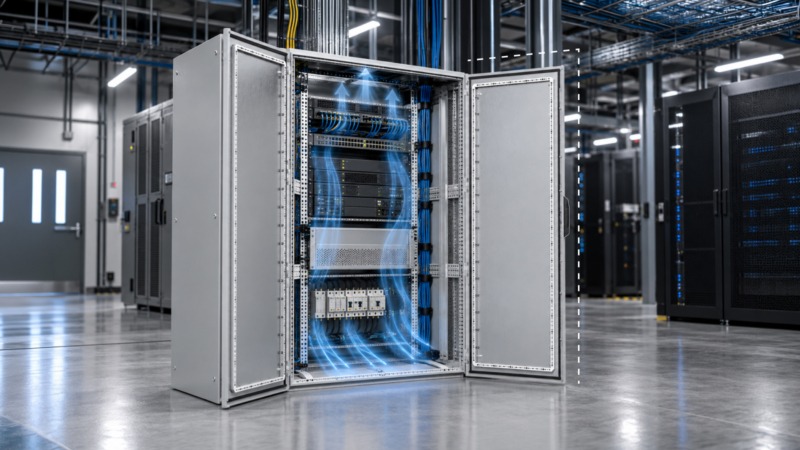
These components must work together to maintain protection without restricting airflow or service access.
At Vikinor, enclosure design balances environmental protection with thermal management to ensure reliable operation under real operating conditions.
IP ratings and thermal management
Higher protection levels often mean more tightly sealed enclosures. While this improves protection against dust and water, it can also create thermal challenges.
Electronic equipment generates heat that must be removed efficiently to prevent overheating.
Typical cooling strategies include:
- Heat exchangers for sealed cooling systems
- DC air conditioners for high heat loads
- Thermoelectric coolers for compact installations
- Thermal insulation to stabilize internal temperatures
Selecting the right cooling solution ensures that protection does not compromise performance.
Choosing the right IP rating for your application
Selecting the correct IP rating depends on the installation environment.
Typical guidelines include:
IP54–IP55
- Indoor industrial environments
- Locations with dust or occasional water spray
IP65
- Outdoor telecom cabinets
- Industrial equipment exposed to weather
IP67 and above
- Environments with potential water immersion
- Specialized industrial applications
The optimal rating balances environmental protection, cooling performance, and cost efficiency.
Key takeaways
- IP ratings define protection against dust and water ingress.
- Higher ratings do not guarantee protection from all environmental risks.
- Enclosure design, sealing, and materials strongly influence real-world protection.
- Thermal management must be considered alongside environmental sealing.
- Selecting the correct IP rating depends on the operating environment.

Latest news & insights