Insights 8 min. read — Oct 16, 2026
Choosing low-GWP refrigerants for industrial enclosure cooling
Selecting the right refrigerant is an important part of designing reliable and energy-efficient cooling systems for electrical enclosures, telecom cabinets, and industrial equipment.
Beyond maintaining stable operating temperatures, refrigerant selection influences environmental impact, cooling performance, system design, safety requirements, and long-term equipment suitability.
As industrial cooling technologies evolve, manufacturers are increasingly adopting refrigerants with lower Global Warming Potential (GWP). However, selecting a lower-GWP refrigerant involves more than comparing environmental ratings.
The refrigerant must also work effectively with the compressor, heat exchangers, expansion components, controls, and operating conditions of the complete cooling system.
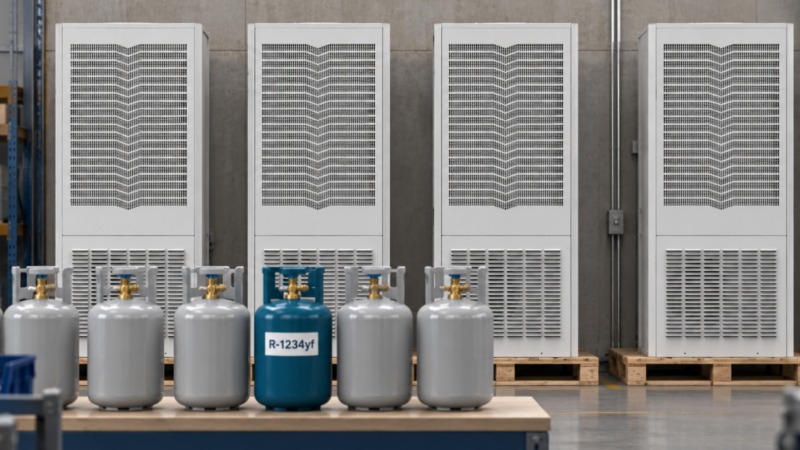
Understanding these relationships is essential when comparing established refrigerants such as R134a with lower-GWP alternatives such as R513A and R1234yf.
Understanding low-GWP refrigerants
Global Warming Potential measures the warming impact of a greenhouse gas relative to carbon dioxide over a defined period.
For refrigeration and air-conditioning systems, a lower refrigerant GWP reduces the potential direct climate impact if refrigerant is released into the atmosphere.
Three refrigerants illustrate the transition taking place in industrial enclosure cooling:
| Refrigerant | GWP100 (AR4 basis) | Safety classification | Characteristics |
|---|---|---|---|
| R134a | 1,430 | A1 | Established HFC refrigerant with comparatively high GWP |
| R513A | 631 | A1 | Lower-GWP HFO/HFC blend with characteristics suitable for many applications historically using R134a |
| R1234yf | 4* | A2L | Very-low-GWP HFO requiring appropriate system design and safety considerations |
*GWP values are shown on an AR4 comparison basis. Reported values can differ between climate assessment methodologies.
R513A reduces GWP significantly compared with R134a while retaining an A1 safety classification. R1234yf reduces the potential climate impact much further but introduces different system-design requirements because of its A2L classification.
GWP alone, however, does not determine the overall environmental performance of a cooling system.
Energy consumption, refrigerant charge, leakage, equipment lifetime, maintenance, and cooling efficiency also contribute to the environmental impact of the complete installation.
Key factors in refrigerant selection
Selecting a refrigerant requires several engineering factors to be considered together.
Cooling performance
Industrial enclosure air conditioners often operate continuously while exposed to high ambient temperatures, changing thermal loads, and demanding environmental conditions.
Changing refrigerant can influence:
- Operating pressures
- Heat-transfer characteristics
- Compressor performance
- Cooling capacity
- Discharge temperatures
- System efficiency
A refrigerant with a lower GWP does not automatically provide better cooling performance or energy efficiency.
Performance depends on how the refrigerant interacts with the complete refrigeration circuit.
For applications such as outdoor telecom cabinets, electrical enclosures, and distributed infrastructure, maintaining sufficient cooling capacity during maximum expected ambient conditions remains a primary requirement.
Energy efficiency
The environmental effect of a refrigerant includes both direct and indirect factors.
Direct impact relates primarily to refrigerant released through leakage or servicing. Indirect impact comes from the energy consumed by the cooling system during operation.
A system using a very-low-GWP refrigerant can therefore still have substantial lifecycle energy consumption if the cooling architecture operates inefficiently.
Refrigerant selection should consequently be considered alongside compressor efficiency, heat exchanger performance, control strategy, thermal load, and expected operating conditions.
Safety classification
Refrigerant safety classification is another important consideration.
R134a and R513A are classified as A1 refrigerants. Under the ASHRAE classification system, this means lower toxicity and no flame propagation under the specified test conditions.
R1234yf is classified as A2L, indicating lower toxicity and lower flammability with limited burning velocity.
The A2L classification introduces additional considerations for equipment design and servicing.
Depending on the application and applicable requirements, these can include:
- Refrigerant charge
- Component compatibility
- Leak prevention
- Ignition sources
- Electrical design
- Ventilation
- Installation conditions
- Service procedures
For compact enclosure air conditioners, these requirements must be integrated while maintaining limited dimensions and the required cooling performance.
System compatibility
Refrigerants should not be evaluated independently of the equipment in which they operate.
Compressors, heat exchangers, expansion devices, seals, lubricants, controls, and other components are selected and validated for particular refrigerant characteristics.
Even refrigerants with similar operating characteristics are therefore not necessarily interchangeable.
The complete cooling system must be engineered and tested around the intended refrigerant.
How refrigerant selection affects cooling technology
Refrigerant choice also depends on the type of cooling system being used.
Compressor-based enclosure air conditioners
Air conditioners provide active cooling when internal enclosure temperatures must remain below ambient conditions.
The refrigerant is an integral part of the vapor-compression cycle and directly influences operating conditions, component selection, environmental characteristics, and safety requirements.
Lower-GWP refrigerants can reduce the potential climate impact associated with leakage, provided the complete cooling system is designed for the refrigerant.
Air conditioners with economizer
Hybrid cooling combines compressor-based refrigeration with economizer cooling when ambient conditions allow.
Using favorable outside temperatures can reduce compressor runtime and energy consumption, while a lower-GWP refrigerant reduces the potential direct climate impact of the refrigeration circuit.
This means environmental performance can be improved through both cooling architecture and refrigerant selection rather than relying on either factor alone.
Thermosiphon heat exchangers
Thermosiphon systems use a sealed refrigerant circuit to transfer heat without continuously operating a compressor.
Natural circulation is driven by temperature and density differences within the refrigerant circuit.
Refrigerant selection must therefore account for passive heat-transfer performance, operating temperatures, system pressure, and the characteristics required for stable thermosiphon operation.
Air-to-air heat exchangers
Conventional air-to-air heat exchangers transfer heat between separated air streams without using a refrigerant circuit.
Where ambient conditions provide a sufficient temperature difference, they can offer an alternative to compressor-based cooling and eliminate refrigerant from the cooling process entirely.
This illustrates why cooling technology should be selected according to the operating environment before focusing solely on refrigerant choice.
Real-world implications for industrial enclosure cooling
The best refrigerant depends partly on where and how the cooling equipment will operate.
Outdoor telecom installations may experience high daytime temperatures, strong solar exposure, and continuous internal heat generation.
Industrial control enclosures may operate around machinery, production equipment, dust, or changing thermal loads.
Edge and distributed IT infrastructure can combine higher equipment density with limited installation space and continuous availability requirements.
Across these applications, lower GWP is valuable, but the cooling system must still provide the required capacity, reliability, environmental protection, and operating range.
A refrigerant transition that compromises thermal performance would simply exchange one engineering problem for another.
Engineering perspective: New equipment vs refrigerant replacement
A distinction should be made between selecting the refrigerant for new cooling equipment and changing the refrigerant in an existing system.
Some lower-GWP refrigerants have operating characteristics that make them suitable alternatives in applications historically served by higher-GWP refrigerants. This does not make them automatic drop-in replacements.
Differences can affect:
- Operating pressure
- Compressor compatibility
- Lubricants
- Seals and materials
- Expansion components
- Refrigerant charge
- Safety classification
- Controls
- Servicing requirements
R513A, for example, combines R1234yf and R134a and retains an A1 safety classification. R1234yf has very different environmental characteristics but is classified as A2L.
Using R1234yf therefore requires a system designed and validated around its refrigerant properties and safety requirements rather than simply replacing the refrigerant in equipment intended for R134a.
For existing industrial cooling installations, any refrigerant change should follow the equipment manufacturer’s requirements and be assessed by appropriately qualified refrigeration specialists.
For new installations, specifying equipment engineered and validated for its intended refrigerant provides the more reliable approach.
Practical guidance for selecting a refrigerant
A structured evaluation can help determine which refrigerant and cooling system are appropriate for an enclosure application.
1. Define the cooling requirement
Determine the thermal load, required internal temperature, maximum ambient temperature, and operating profile.
2. Consider the installation environment
Evaluate whether the equipment will operate indoors, outdoors, remotely, or in an industrial environment and identify relevant environmental and safety constraints.
3. Compare refrigerant environmental characteristics
Consider GWP and the potential climate impact associated with the refrigerant charge and possible leakage.
4. Evaluate cooling performance
Confirm that the complete cooling system provides sufficient capacity and efficiency across the required operating range.
5. Review safety classification
Determine whether the refrigerant is A1, A2L, or another safety classification and understand the resulting equipment and installation requirements.
6. Confirm system compatibility
Use cooling equipment specifically designed and validated for the intended refrigerant rather than assuming different refrigerants are interchangeable.
7. Consider lifecycle performance
Evaluate refrigerant characteristics together with energy consumption, maintenance requirements, equipment lifetime, serviceability, and expected operating conditions.
Key takeaways
- Refrigerant selection affects environmental impact, cooling performance, safety, and system design.
- R134a has a significantly higher GWP than newer alternatives such as R513A and R1234yf.
- R513A provides lower GWP while retaining an A1 safety classification.
- R1234yf provides very low GWP but has an A2L safety classification that requires appropriate system design.
- Lower GWP does not automatically mean greater energy efficiency.
- Refrigerants should be evaluated as part of the complete cooling system rather than as interchangeable fluids.
- Cooling technology and operating environment should be considered alongside refrigerant characteristics.
- New equipment designed and validated for its intended refrigerant provides a more reliable approach than assuming an existing system can simply be converted.
Further reading

Latest news & insights