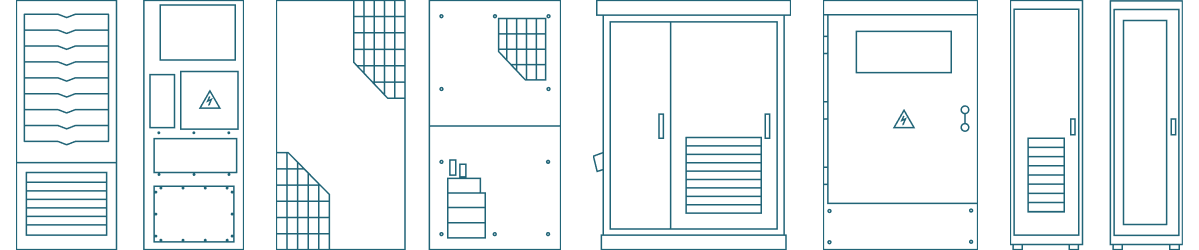
Low-voltage switchgear
Glossary defaultDefinition
Low-voltage switchgear is equipment used to control, protect, isolate, and distribute electrical power in low-voltage electrical systems.
A switchgear assembly can include circuit breakers, switches, fuses, busbars, protective devices, control equipment, and monitoring systems installed within an enclosure or cabinet.
Low-voltage switchgear is used throughout commercial, industrial, data center, telecom, energy, and critical infrastructure to distribute power safely while protecting electrical circuits and connected equipment from faults.
Context
Electrical power must be distributed from its source to individual loads while providing a means to control circuits and protect equipment from abnormal electrical conditions.
Low-voltage switchgear performs these functions at different points within an electrical distribution system.
Depending on the application, it can provide:
- Power distribution
- Circuit switching
- Electrical isolation
- Overcurrent protection
- Short-circuit protection
- Equipment control
- Electrical monitoring
The design and configuration of the switchgear depend on system voltage, current, fault levels, connected loads, operating environment, required availability, and applicable electrical standards.
In critical infrastructure, switchgear design can also influence system reliability and maintainability because faults or maintenance activities within the electrical distribution system can affect equipment availability.
Technical insight
Low-voltage switchgear combines multiple electrical devices into an integrated assembly that manages the flow of electrical power.
The exact configuration varies significantly depending on the electrical architecture and application.
Switching and isolation
Switching devices allow electrical circuits to be connected or disconnected during normal operation.
Isolation provides a means of separating equipment or sections of an electrical system from the power source so that inspection, maintenance, or other work can be performed safely.
Depending on the system design, switching and isolation functions may be performed by circuit breakers, switches, disconnectors, or combinations of different devices.
Circuit protection
Electrical faults can produce currents significantly above normal operating levels.
Protective devices detect or respond to abnormal electrical conditions and interrupt the affected circuit before excessive current causes further damage to conductors or connected equipment.
Circuit breakers and fuses are commonly used to provide overcurrent and short-circuit protection.
The protection strategy must be coordinated across the electrical distribution system so that a fault can be isolated as close as practical to the affected circuit without unnecessarily interrupting unaffected loads.
Busbars and power distribution
Busbars provide conductive paths for distributing electrical power between incoming supplies and outgoing circuits within the switchgear assembly.
Their dimensions and configuration depend on factors such as rated current, short-circuit withstand requirements, system architecture, and physical arrangement.
Outgoing circuits then distribute power to downstream equipment, additional distribution boards, or individual loads.
Monitoring and control
Modern low-voltage switchgear can incorporate monitoring and control systems that provide greater visibility into electrical operation.
Depending on the installation, monitored parameters can include:
- Voltage
- Current
- Power
- Energy consumption
- Circuit status
- Breaker status
- Alarms
- Power quality
Remote monitoring can be particularly useful in distributed or critical infrastructure where electrical equipment operates across multiple locations.
Ratings and system design
Low-voltage switchgear must be selected according to the electrical characteristics of the system.
Important parameters can include:
- Rated operational voltage
- Rated current
- Short-circuit rating
- Frequency
- Number of phases
- Ingress protection
- Environmental conditions
- Internal separation
- Applicable standards
Electrical ratings must be considered together rather than independently. For example, equipment with sufficient continuous current capacity must also be capable of safely handling the prospective fault conditions at its installation point.
Low-voltage switchgear vs distribution board
Low-voltage switchgear and distribution boards both perform electrical distribution and protection functions, but the terms describe different types and scales of electrical assemblies.
A power distribution board typically distributes an incoming electrical supply across multiple outgoing circuits using protective and switching devices.
Low-voltage switchgear is a broader term that can describe more complex assemblies incorporating switching, isolation, protection, busbars, control, monitoring, and power distribution functions.
The appropriate terminology depends on the system architecture, equipment configuration, applicable standards, and application.
Key advantages
- Controls and distributes electrical power
- Provides circuit and equipment protection
- Enables electrical isolation
- Supports coordinated fault protection
- Enables monitoring and control
- Supports reliable electrical distribution
Applications
Low-voltage switchgear is used throughout infrastructure requiring controlled and protected electrical power distribution.
Data center and IT infrastructure
Modern data center and IT infrastructure uses low-voltage switchgear to distribute electrical power between utility supplies, generators, backup power systems, power distribution equipment, and critical IT loads.
Telecom and connectivity
Telecom and connectivity infrastructure uses low-voltage distribution and switching equipment to supply network equipment, cooling systems, battery systems, and other supporting site infrastructure.
Industrial automation
Electrical systems supporting industrial automation use switchgear to control and protect power supplied to machinery, control systems, drives, and other industrial loads.
Energy and grid infrastructure
Low-voltage switchgear is used throughout energy and grid infrastructure to distribute and protect electrical power within generation, storage, conversion, and grid-supporting systems.
Oil, gas and mining
Electrical installations within oil, gas and mining applications use switchgear to control and protect power distribution to equipment operating across demanding industrial environments.
Defense and security
Critical electrical systems used in defense and security applications can use low-voltage switchgear to provide protected and controlled power distribution for communications, computing, surveillance, and supporting infrastructure.
FAQ
Low-voltage switchgear is an assembly of switching, protection, isolation, control, and distribution equipment used to manage electrical power within low-voltage systems.
Depending on the design, low-voltage switchgear can include circuit breakers, switches, fuses, busbars, protective devices, control equipment, meters, and monitoring systems.
A distribution board primarily distributes an incoming electrical supply across multiple protected outgoing circuits. Switchgear is a broader concept that can incorporate more extensive switching, isolation, protection, control, monitoring, and distribution functions.
The exact definition depends on the applicable standard and context. Under IEC terminology, low voltage generally refers to electrical systems up to 1,000 V AC or 1,500 V DC.
Infrastructure solutions