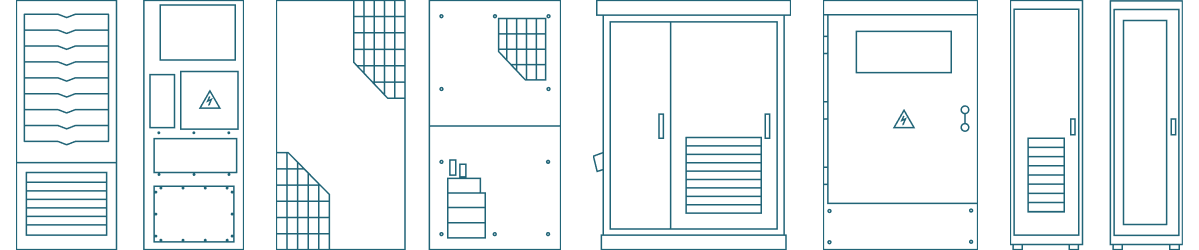
Battery cabinet
Glossary protectionDefinition
A battery cabinet is an enclosure designed to safely house batteries, battery modules, electrical components, and associated monitoring and protection systems. It protects energy storage equipment from environmental conditions while supporting temperature control, electrical safety, and reliable operation.
Battery cabinets are commonly used in Battery Energy Storage Systems (BESS), telecom backup power systems, renewable energy installations, industrial facilities, and other critical infrastructure applications.
Context
As energy storage becomes increasingly important for renewable energy integration, grid stability, and backup power, battery cabinets have become a key part of modern power infrastructure.
Beyond simply containing batteries, today’s battery cabinets are engineered systems that integrate thermal management, ventilation or cooling, electrical distribution, monitoring, and safety features within a compact enclosure.
Depending on the application, battery cabinets may be installed indoors or outdoors and are designed to protect batteries from temperature extremes, moisture, dust, corrosion, and unauthorized access.
Technical insight
A battery cabinet combines physical protection with environmental control to create a suitable operating environment for energy storage equipment.
A typical battery cabinet may contain:
- Battery modules
- Battery Management System (BMS)
- Power distribution equipment
- Cooling or ventilation systems
- Fire detection and suppression systems
- Monitoring and communication equipment
The enclosure itself plays an important role in maintaining battery performance by supporting stable operating temperatures and protecting sensitive electrical equipment from external conditions.
Thermal management
Battery performance is highly dependent on temperature.
Battery cabinets often integrate:
The appropriate cooling strategy depends on battery chemistry, ambient conditions, power density, and installation requirements.
Environmental protection
Outdoor battery cabinets are designed to withstand challenging operating environments.
Protection may include:
- Weather resistance
- Corrosion protection
- Dust protection
- Water ingress protection
- UV-resistant finishes
The required level of protection depends on the installation location and environmental exposure.
Safety systems
Modern battery cabinets incorporate multiple safety features that help reduce operational risk.
Typical systems include:
- Battery monitoring
- Temperature sensors
- Smoke detection
- Fire suppression
- Access control
- Alarm systems
These systems help maintain reliable operation while supporting applicable safety standards and regulations.
Key advantages
- Protects batteries from environmental conditions
- Supports stable operating temperatures
- Improves battery reliability and lifespan
- Integrates cooling, monitoring, and safety systems
- Supports indoor and outdoor installations
- Simplifies deployment of energy storage systems
Applications
Battery cabinets are commonly used in:
Battery energy storage systems (BESS)
Battery cabinets provide the physical infrastructure for utility-scale and commercial energy storage installations.
Telecom infrastructure
Telecom sites use battery cabinets to provide backup power during grid outages.
Renewable energy systems
Solar and wind installations use battery cabinets to store generated energy and improve power availability.
Industrial facilities
Industrial sites use battery cabinets to support critical processes and maintain operational continuity.
Critical infrastructure
Utilities, transportation networks, healthcare facilities, and data centers use battery cabinets to improve resilience and backup power capability.
FAQ
A battery cabinet is an enclosure designed to house batteries, electrical equipment, and safety systems while protecting them from environmental conditions and supporting reliable operation.
A Battery Energy Storage System (BESS) is the complete energy storage solution, while a battery cabinet is one physical component that houses batteries and supporting equipment.
Maintaining stable operating temperatures helps improve battery performance, extend service life, and support safe, reliable operation.
protection solutions